

29th Euromicro Conference Series on
Digital System Design (DSD) 2026
Call for Papers
29th Euromicro Conference Series on Digital System Design (DSD) 2026 will be held at the AGH Univeristy of Kraków, Poland, from 2nd to 4th of September 2026.
Scope:
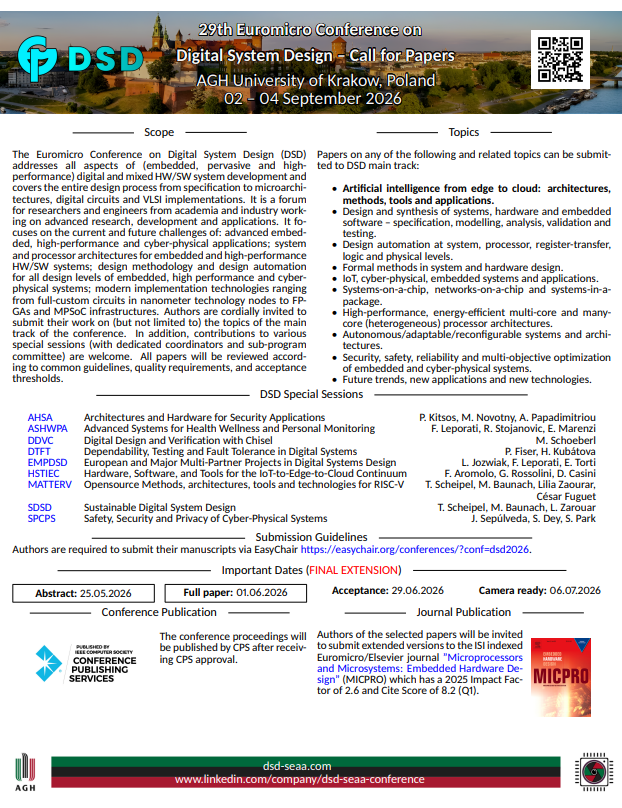
The Euromicro Conference on Digital System Design (DSD) addresses all aspects of (embedded, pervasive and high-performance) digital and mixed HW/SW system development and covers the entire design process from specification to microarchitectures, digital circuits and VLSI implementations. It is a forum for researchers and engineers from academia and industry working on advanced research, development and applications. It focuses on the current and future challenges of: advanced embedded, high-performance and cyber-physical applications; system and processor architectures for embedded and high performance HW/SW systems; design methodology and design automation for all design levels of embedded, high performance and cyber-physical systems; modern implementation technologies ranging from full-custom circuits in nanometer technology nodes to FPGAs and MPSoC infrastructures. Authors are cordially invited to submit their work on (but not limited to) the topics of the main track of the conference. In addition, contributions to various special sessions (with dedicated coordinators and sub-program committees) on specific topics of special interest are welcome. All papers will be reviewed according to common guidelines, quality requirements and acceptance thresholds.
Main Topics
- Artificial intelligence from edge to cloud: architectures, methods, tools and applications
- Design and synthesis of systems, hardware and embedded software – specification, modelling, analysis, validation and testing
- Design automation at system, processor, register-transfer, logic and physical levels
- Formal methods in system and hardware design
- IoT, cyber-physical, embedded systems and applications
- Systems-on-a-chip, networks-on-a-chip and systems-in-a-package
- High-performance, energy-efficient multi-core and many-core (heterogeneous) processor architectures.
- Autonomous/adaptable/reconfigurable systems and architectures
- Security, safety, reliability and multi-objective optimization of embedded and cyber-physical systems
- Future trends, new applications and new technologies
Special sessions
- AHSA: Architectures and Hardware for Security Applications, A. Papadimitriou (University of Peloponnese, GR), P. Kitsos (University of Peloponnese, GR), M. Novotny (CTU Prague, CZ)
- ASHWPA: Advanced Systems for Health Wellness and Personal Monitoring, F. Leporati (U Pavia, IT), R. Stojanovic (U Montenegro, ME), E. Marenzi (U Pavia, IT)
- DDVC: Digital Design and Verification with Chisel, M. Schoeberl (DTU, DK)
- DTFT: Dependability, Testing and Fault Tolerance in Digital Systems, P. Fiser (CTU Prague, CZ), H. Kubátová (CTU in Prague, CZ)
- EMPDSD: European and Major Multi-Partner Projects in Digital Systems Design, F. Leporati (U Pavia, IT), E. Torti (U Pavia, IT)
- HSTIEC: Hardware, Software, and Tools for the IoT-to-Edge-to-Cloud Continuum, F. Aromolo (Scuola Superiore Sant’Anna, IT), D. Casini (Scuola Superiore Sant’Anna, IT), G. Rossolini (Scuola Superiore Sant’Anna, IT)
- MATTERV : Opensource Methods, architectures, tools and technologies for RISC-V, T. Scheipel (Graz University of Technology, AT), M. Baunach (Graz University of Technology, AT), Lilia Zaourar (CEA LIST LCE, FR), César Fuguet (Inria, FR)
- SDSD: Sustainable Digital System Design, T. Scheipel (Graz University of Technology, AT), M. Baunach (Graz University of Technology, AT), Lilia Zaourar (CEA LIST LCE, FR)
- SPCPS: Safety, Security and Privacy of Cyber-Physical Systems, S. Dey (IIT Kharagpur, India), S. Park (TU Berlin, D), J. Sepúlveda (Airbus Defence and Space GmbH, D)
Submission guidelines
- Authors are required to submit their manuscripts via the EasyChair web service at the web page https://easychair.org/conferences/?conf=dsd2026. Should an unexpected web access problem be encountered, please contact the Program Chairs Paolo Burgio and Miguel Figueroa
- Each manuscript should include the complete paper text, all illustrations, and references. The manuscript should conform to the IEEE format: single-spaced, double-column, US letter page size, 10-point size Times Roman font, up to 8 pages. Papers with at most two extra pages are allowed, subject to mandatory overlength page charges (80 EUR/page) to be purchased at the camera-ready submission of accepted papers. In order to conduct a double-blind review, no indication of the authors’ names should appear in the manuscript, references included. However, but authors should not hide previous work, instead, they need to make self-references in the third person.
- All papers will be reviewed according to common guidelines, quality requirements, and acceptance thresholds. Program Chairs reserve the possibility to transfer papers between the main track and the special sessions so that each paper is reviewed in the track in which it fits best.
No-Show Policy
Please take note that the conference has a strict policy on no-show. Therefore, if your paper is accepted, one of the authors and their representatives MUST PRESENT their paper at the conference.
Conference Publication
 The conference proceedings will be published by CPS after receiving CPS approval.
Journal Publication
 Authors of the selected best papers will be invited to submit extended versions of their research to the ISI indexed Euromicro/Elsevier journal ”Microprocessors and Microsystems: Embedded Hardware Design” (MICPRO) which has a 2024 Impact Factor of 2.6 and Cite Score of 8.2 (Q1).
Indexing
The proceedings of the DSD conference will be submitted to the following databases:
|
|
Important dates
- Deadline for paper submission (FINAL EXTENSION):
May 11th, 2026,May 25th, 2026 (abstract), June 1st, 2026 (full paper) - Notification of acceptance: June 29nd, 2026
- Camera-ready papers: July 10th, 2026 (A.O.E)
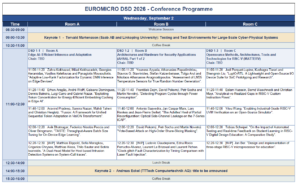
Program
Registration
Registration will be open from 30th June 2026 and will close on 4th September 2026 (including possible on-site registration).
Venue information
The Conference will be held at the AGH University of Kraków. The venue is located in building B8 on the AGH campus.
Address: B-8, aleja Adama Mickiewicza 30/0.24, 30-059 Kraków
Venue contact is Tomasz Kryjak (email: tomasz.kryjak@agh.edu.pl, tel: +48 126173486).
More information about the venue and practical details is available in the Venue tab.
Committees
DSD Steering Committee:
- Tomasz Kryjak (AGH University of Krakow, PL) – Chairman
- Paris Kitsos (University of Peloponnese, GR) – Vice-Chairman
- Lech Jóźwiak (Eindhoven University of Technology, NL) – Honorary Chairman
- Daniel Casini (School of Advanced Studies Sant’Anna, IT)
- Hana Kubatova (Czech Technical University in Prague, CZ)
- Francesco Leporati (University of Pavia, IT)
- José Silva Matos (University of Porto, PT)
- Smail Niar (Polytechnic University of Hauts de-France, FR)
- António Nuñez (University of Las Palmas de Gran Canaria, ES)
- Eugenio Villar (University of Cantabria, ES)
DSD 2026 General Chairs:
- Tomasz Kryjak (AGH University of Krakow, PL)
- Marek Gorgon (AGH University of Krakow, PL)
DSD 2026 Program Chairs:
- Paolo Burgio (University of Modena and Reggio Emilia, IT)
- Miguel Figueroa (Universidad de Concepción, CL)
DSD 2026 Publicity Chair:
- João Canas Ferreira (Univeristy of Porto, PT)
DSD 2026 Finance Co-Chairs:
- Francesco Leporati (University of Pavia, IT)
- Karl-Erwin Grosspietsch (Euromicro, DE)
DSD 2026 Web Co-Chairs:
- Mateusz Wąsala (AGH University of Krakow, PL)
- Hubert Szolc (AGH University of Krakow, PL)
DSD 2026 Technical Program Committee:
- Tom Vander Aa (IMEC, Belgium)
- José L. Abellán (University of Murcia, Spain)
- Irune Agirre (IKR, Spain)
- Mohammad Hasan Ahmadilivani (Mojtaba) (Tallinn University of Technology, Estonia)
- Liliana Andrade (Universite Grenoble Alpes, France)
- Federico Aromolo (Scuola Superiore Sant’Anna, Italy)
- César Azurdia (Universidad de Chile, Chile)
- Mohamed Benazouz (CEA LIST DILS LISE, France)
- Fabien Bouquillon (IRIT, France)
- Alessandro Capotondi (University of Modena and Reggio Emilia, Italy)
- Pedro P. Carballo (University of Las Palmas de Gran Canaria, Spain)
- Antonio Carlos Schneider Beck (Federal University of Rio Grande do Sul, Brazil)
- Gonzalo Carvajal (Universidad Técnica Federico Santa María, Chile)
- Daniel Casini (School of Advanced Studies Sant’Anna, Italy)
- Roberto Cavicchioli (University of Modena and Reggio Emilia, Italy)
- Stefano Cherubin (NTNU, Norway)
- Alessandro Cilardo (University of Naples Federico II, Italy)
- Marcello Cinque (University of Naples Federico II, Italy)
- Silviu Craciunas (TTTech Computertechnik AG, Austria)
- Giovanni Danese (University of Pavia, Italy)
- Karol Desnos (INSA Rennes, France)
- Tiago Dias (Instituto Superior de Engenharia de Lisboa, Portugal)
- Rolf Drechsler (University of Bremen, Germany)
- João Canas Ferreira (Univeristy of Porto, Portugal)
- Petr Fišer (Czech Technical University in Prague, Czech Republic)
- Francisco Garcia-Herrero (Universidad Complutense de Madrid, Spain)
- Ghayoor Gillani (University of Twente, The Netherlands)
- Roberto Giorgi (University of Siena, Italy)
- Giovani Gracioli (Federal University of Santa Catarina, Brazil)
- Kim Grüttner (DLR, Germany)
- Miguel Guitierrez Gaitan (Pontificia U. Católica de Chile, Chile)
- Zhishan Guo (North Carolina State University, USA)
- Mohamed Hassan (McMaster University, Canada)
- Carles Hernandez (Universitat Politècnica de València, Spain)
- Roel Jordans (Eindhoven University of Technology, The Netherlands)
- Lech Jozwiak (Eindhoven University of Technology, The Netherlands)
- Oliver Keszocze (University of Erlangen–Nuremberg, Germany)
- Paris Kitsos (University of Peloponnese, Greece)
- Josip Knezovic (University of Zagreb, Croatia)
- Mateusz Komorkiewicz (AGH University of Krakow, Poland)
- Marcin Kowalczyk (AGH University of Krakow, Poland)
- Marek Kraft (Poznań University of Technology, Poland)
- Tomasz Kryjak (AGH University of Krakow, Poland)
- José L. Abellán (University of Murcia, Spain)
- Alexey Lastovetsky (University College Dublin, Irleand)
- Francesco Leporati (University of Pavia, Italy)
- Alberto Marchisio (New York University, USA)
- Maurizio Martina (Polytechnic University of Turin, Italy)
- Jose Matos (University of Porto, Portugal)
- Enrico Mezzetti (BSC, Spain)
- Antonio Miele (Polytechnic University of Milan, Italy)
- Hasan Monowar (Washington State University, USA)
- Vojtech Mrazek (Brno University of Technology, Czech Republic)
- Pietro Nannipieri (University of Pisa, Italy)
- Nadia Nedjah (State University of Rio de Janeiro, Brazil)
- Smail Niar (Polytechnic University of Hauts de-France, France)
- Stefan Nikolić (University of Novi Sad, Serbia)
- Martin Novotny (Czech Technical University in Prague, Czech Republic)
- António Nuñez (University of Las Palmas de Gran Canaria, Spain)
- Roman Obermaiser (University of Siegen, Germany)
- Arnaldo Oliveira (University of Aveiro, Portugal)
- Alex Orailoglu (University of California San Diego, USA)
- Theofanis Orphanoudakis (Hellenic Open University, Greece)
- Andres Otero (UPM, Spain)
- Antonio Paolillo (Vrije Universiteit Brussel, Belgium)
- Lazaros Papadopoulos (Democritus University of Thrace, Greece)
- Luis Miguel Pinho (Instituto Politécnico do Porto, Portugal)
- Andrea Pinna (Sorbonne University, France)
- Sai Manoj Pudukotai Dinakarrao (George Mason University, USA)
- Davide Quaglia (University of Verona, Italy)
- Alfonso Rodriguez (Technical University of Madrid, Spain)
- Gabriel Saavedra (Universidad de Concepción, Chile)
- Sepideh Safari (Institute for Research in Fundamental Sciences (IPM), Iran)
- Mazen Saghir (American Univeristy of Beirut, Lebanon)
- Tobias Scheipel (Graz University of Technology, Austria)
- Jan Schmidt (Czech Technical University in Prague, Czech Republic)
- Olivier Sentieys (University of Rennes, France)
- Ricardo Severino (INESC-TEC/ISEP, Portugal)
- Jose Silva Matos (University of Porto, Portugal)
- Kostas Siozios (Aristotle University of Thessaloniki, Greece)
- Michal Sojka (Czech Technical University in Prague, Czech Republic)
- Andreas Steininger (TU Wien, Austria)
- Radovan Stojanovic (University of Montenegro, University of Montenegro)
- Hoon Sung Chwa (DGIST, Sout Korea)
- George Theodoridis (University of Patras, Greece)
- Emanuele Torti (University of Pavia, Italy)
- Ioannis Vourkas (Democritus University of Thrace, Greece)
- Chao Wang (University of Science and Technology of China, China)
- Arda Yurdakul (Boğaziçi University, Turkey)
- Marcela Zachariášová (Brno University of Technology, Czech Republic)
- Houssam-Eddine Zahaf (University of Nantes, France)
- Lilia Zaourar (CEA, France)
Feel free to contact us regarding any information or queries.
Transparency page with details on the conference policies is available here.
Detailed information of the conference chairs
General Chairs
Tomasz Kryjak
AGH University of Krakow, Poland
kryjak@agh.edu.pl
al. Adama Mickiewicza 30, 30-059 Kraków, Poland
+48 126173486
Marek Gorgoń
AGH University of Krakow, Poland
mago@agh.edu.pl
al. Adama Mickiewicza 30, 30-059 Kraków, Poland
+48 126174941
Finance Chairs
Francesco Leporati
University of Pavia, Italy
francesco.leporati@unipv.it
via Ferrata 5, Pavia, Italy, 27100
+39 0382 985678
Karl-Erwin Grosspietsch
Euromicro, Germany
grosspietsch@euromicro.org
Moselstrasse 6, 53757 Sankt Augustin, Germany
+49 696315830